
Smoke Shop Inventory Starter Guide
Building the right inventory is one of the most important decisions when opening a smoke shop or expanding an existing retail store.
The goal isn’t simply to fill every available shelf. A good starting inventory gives customers enough variety while allowing you to learn which products, styles and price points actually sell in your location.
This guide covers some of the core smoking-accessory categories retailers should consider, how to approach product variety, and ways to avoid tying up too much money in inventory before you know what your customers want.
What Inventory Does a Smoke Shop Need?
There isn’t one inventory list that works for every smoke shop.
Your ideal product mix will depend on your customers, location, available shelf space, competition and the amount of money you want to invest in opening inventory.
A dedicated smoke shop may carry considerably more glass and accessories than a convenience store adding a small smoking-accessory section. Stores near one another can also develop very different best sellers.
That’s why a new retailer should think in terms of categories and assortment, rather than simply buying large quantities of individual products.
Start with enough variety to learn what customers want. Once sales data begins coming in, you can increase inventory of proven sellers and reduce spending on slower-moving products.
Smoke Shop Inventory Checklist
A smoke shop inventory checklist can help you plan an initial assortment without overlooking important product categories or putting too much money into individual products before you know what will sell.
Instead of treating the checklist as a fixed shopping list, use it as a starting point. Choose the categories that fit your store, carry enough variety to test customer demand, and then adjust quantities using actual sales and reorder data.
A useful inventory checklist should track more than which products you carry. For each SKU, consider recording the product category, quantity on hand, target stock level, reorder point, wholesale cost, retail price and supplier. This makes the checklist useful after opening day as an ongoing inventory-management tool.
Category
Examples
Track
Glass
Water pipes, bubblers, pipes
Qty / Reorder Point
Bowls & Accessories
Replacement bowls, accessories
Qty / Reorder Point
Grinders
Multiple sizes and price points
Qty / Reorder Point
Rolling
Papers, trays, accessories
Qty / Reorder Point
Lighters & Torches
Everyday and specialty options
Qty / Reorder Point
Dabbing Accessories
Tools, containers, accessories
Qty / Reorder Point
Storage & Cleaning
Storage and maintenance products
Qty / Reorder Point
Tip: Leave room in your opening inventory budget for reorders. Your first weeks of sales will provide better information about what your customers want than any generic inventory list can.
Free Printable Smoke Shop Inventory Checklist
Want an easier way to plan and track your store’s inventory? Download our free printable Smoke Shop Inventory Checklist. The worksheet includes space to track products and SKUs, starting quantities, current stock, reorder points, wholesale costs, retail prices, margins and suppliers.
Use the worksheet as a starting point and adjust your inventory levels as you learn which products sell fastest in your store.
Core Smoke Shop Inventory Categories
The following categories can provide a foundation for a smoking-accessory selection.
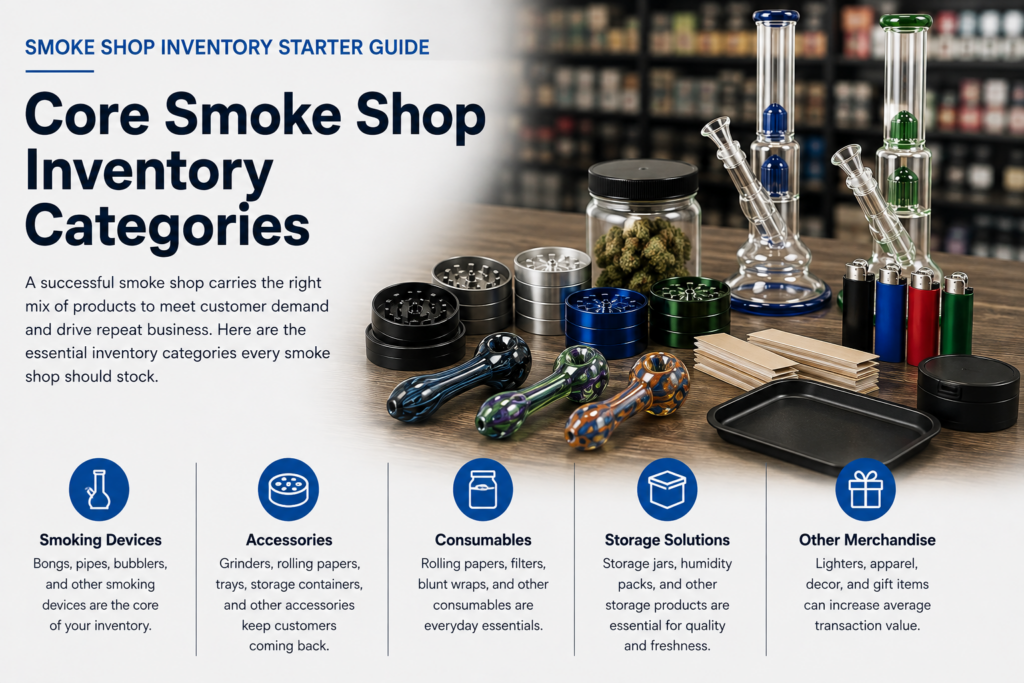
Water Pipes, Bubblers & Glass Pipes
Glass can provide retailers with products across a wide range of designs and price points.
Rather than purchasing too many units of the same design initially, consider offering customers a selection of sizes, styles and prices. As certain products begin selling consistently, you can increase reorder quantities accordingly.
Glass Bowls & Pipe Accessories
Replacement bowls and related accessories can complement a store’s glass selection.
These products generally require relatively little display space and give customers a reason to return when they need a replacement or additional accessory.
Grinders
Grinders are a staple accessory that can be offered across multiple sizes, materials, designs and price points.
They’re also easy to merchandise alongside rolling papers, trays and other complementary products.
For a new store, carrying several different options can help you determine whether customers favor inexpensive basic grinders or larger/premium designs.
Rolling Trays
Rolling trays give retailers another relatively simple way to introduce variety.
Different sizes, colors and designs allow customers to choose based on personal preference, and trays can be displayed alongside grinders, papers and other rolling accessories.
Rolling Papers & Rolling Accessories
Consumable products can be particularly useful because customers need to replenish them.
Rolling papers and related accessories can complement grinders, trays and lighters while giving customers another reason to return to the store.
Consider offering several formats and price points rather than relying entirely on one option.
Torches & Lighters
Lighters and torches can serve as both essential accessories and add-on purchases.
Depending on your store, you may want a combination of inexpensive everyday options and higher-priced specialty torches.
Dabbing Accessories
Stores serving customers who use concentrates may want to dedicate part of their inventory to dab tools, containers and related accessories.
Rather than heavily stocking every accessory immediately, introduce a useful assortment and expand based on actual customer demand.
Storage & Cleaning Supplies
Cleaning and storage products are easy to overlook when planning opening inventory, but they complement products customers already own.
Cleaning supplies, storage containers and maintenance accessories can also provide opportunities for repeat purchases.
How Much Smoke Shop Inventory Should You Start With?
There’s no universal dollar amount that every new smoke shop should spend on inventory.
A better approach is to work backward from your available inventory budget and decide how much you want to allocate to each category.
Avoid putting a disproportionate amount of your starting budget into one product simply because you received a better unit price for purchasing a large quantity.
For example, a new retailer may benefit more from carrying several grinder styles than owning a large quantity of one grinder before knowing whether customers will buy it.
The same principle applies to glass, trays, torches and other products where customer preferences can vary considerably.
Your initial inventory should help you learn.
Once you’ve collected actual sales information, your purchasing decisions can become increasingly data-driven.
Variety vs. Quantity: Which Matters More?
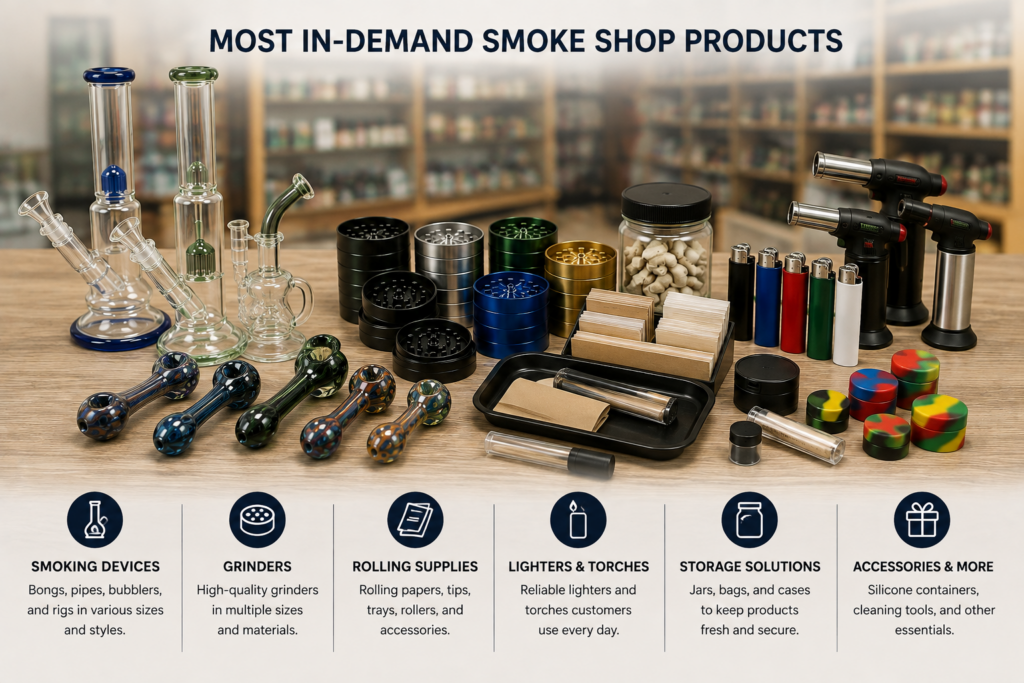
When you’re starting out, variety can often be more useful than depth.
Imagine choosing between:
50 units of one grinder
and
five units each of 10 different grinders.
The first option gives you excellent depth if you’ve correctly predicted the product customers want.
The second gives you an opportunity to discover which sizes, colors, designs and price points customers actually prefer.
Once you identify the winners, you can increase the quantity of those products on subsequent orders.
This doesn’t mean every product needs to be purchased in tiny quantities forever. Established best sellers often deserve deeper inventory.
The objective is to earn the confidence to buy deeper through actual sales data, rather than guessing before you’ve made the first sale.
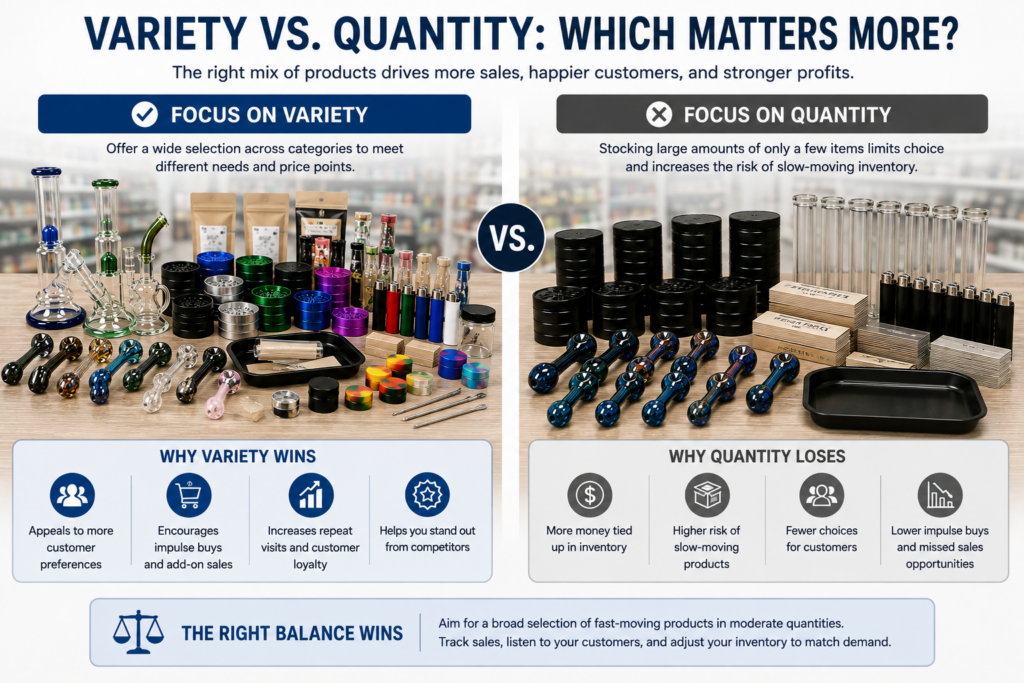
Don’t Spend Your Entire Inventory Budget at Once
Opening inventory is only the beginning.
After your doors open, customers will immediately start telling you what your inventory is missing.
They’ll ask for different sizes, designs, price points and products you may not have considered.
Keeping some purchasing capital available allows you to respond to that information.
If your entire inventory budget is already sitting on the shelves, responding to unexpected demand becomes more difficult.
A more flexible approach is to establish a solid initial assortment, watch what customers request and purchase, and then use subsequent orders to improve the product mix.
Use Complementary Products to Build a Better Assortment
Think about products in groups rather than completely separate categories.
A customer buying rolling papers may also need:
A grinder
A rolling tray
A lighter
Storage accessories
A customer purchasing glass may eventually need:
Replacement bowls
Cleaning supplies
Storage products
Other accessories
Carrying complementary products makes the store more useful to customers and can create opportunities to increase the value of individual transactions.
This is one reason a well-rounded accessory assortment can be more useful than putting most of an inventory budget into only one or two categories.
Watch Your Inventory Turnover
Once your store is operating, one of the most useful questions you can ask is:
How quickly is this product actually selling?
A product with a high markup isn’t necessarily a great inventory investment if it sits on the shelf for a year.
Likewise, a product with a smaller profit per unit can be valuable if customers purchase it consistently and inventory turns quickly.
Pay attention to:
Which SKUs sell consistently
Which products require frequent reorders
Which price points perform best
Which categories generate repeat purchases
Which products sit unsold
Which products customers repeatedly request
Your point-of-sale system can become an important purchasing tool.
Over time, your actual sales data should determine more of your inventory decisions than assumptions about what should sell.
Avoid Overstocking Slow-Moving Products
Buying larger quantities usually reduces your cost per unit.
That doesn’t automatically make it the better financial decision.
Suppose you save $1 per unit by purchasing 48 pieces instead of 12.
If the additional 36 pieces take a year to sell, the savings may not justify having your money tied up in inventory for that long.
This is particularly important with products driven by design preferences.
Glass, trays, grinders and similar products can change in popularity, and customers may prefer variety over seeing dozens of identical pieces.
Lower quantities give retailers an opportunity to test products before increasing their commitment.
Make Reordering Easy
Your initial order receives a lot of attention, but the long-term goal should be creating a reliable replenishment system.
When a product sells well, you should be able to identify it quickly and reorder it.
That’s why consistent SKU and UPC information can matter.
Clear product identification helps retailers track inventory, understand what’s selling and find the same products again when it’s time to restock.
Repleno products include retail-ready UPC and SKU labeling where applicable to make receiving and inventory management easier.
Consider a Smoke Shop Starter Pack
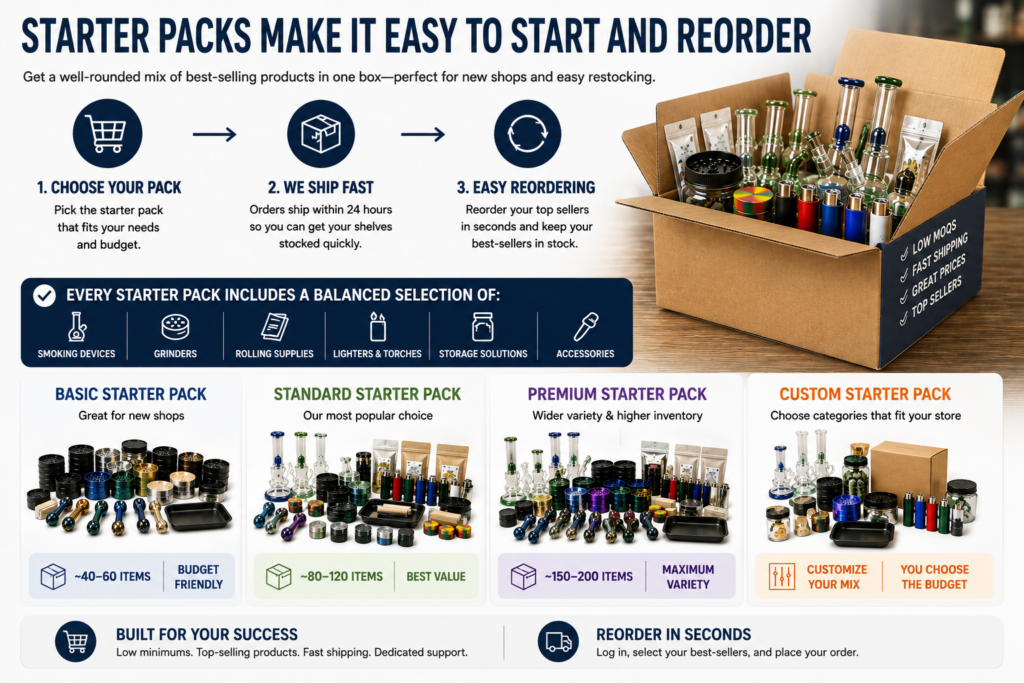
If you’re opening a new store or adding smoking accessories to an existing business, selecting every product individually can be time consuming.
A wholesale Starter Pack provides another option.
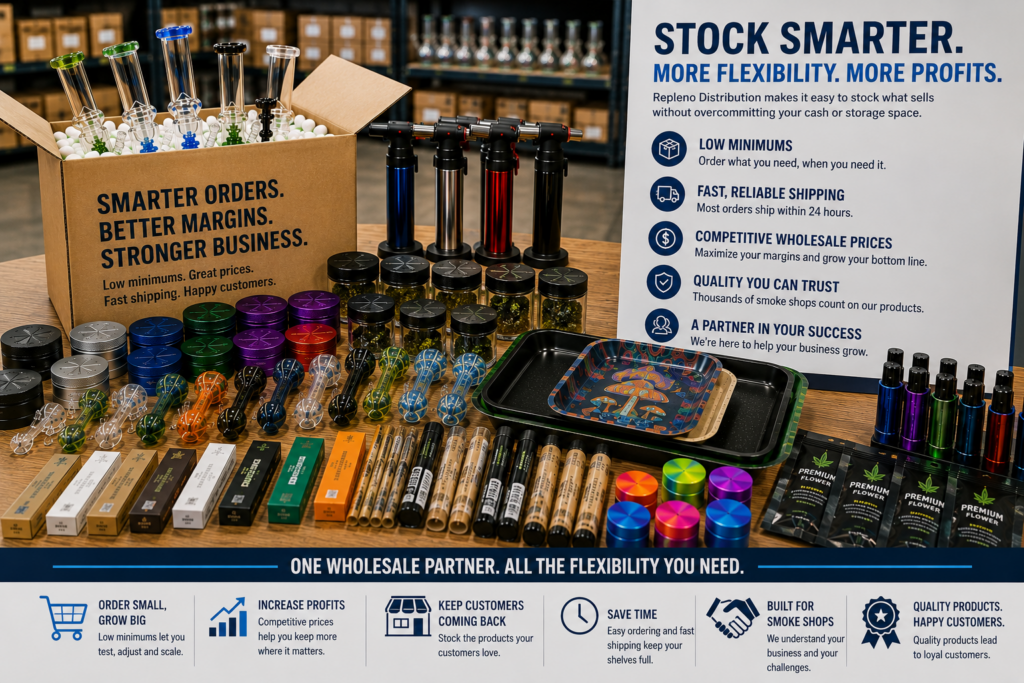
Repleno Starter Packs combine products from multiple smoking-accessory categories into a single assortment, giving retailers a straightforward way to establish or expand their selection.
You can then use customer demand and sales data to determine which products and categories to reorder more heavily.
Choosing a Wholesale Smoke Shop Supplier
Price matters, but it shouldn’t be the only consideration when evaluating a supplier.
Retailers should also consider:
Minimum quantities
Product selection
Inventory consistency
Shipping speed
Shipping costs
Product identification and barcodes
Damaged-product policies
Ease of reordering
Customer service
The best supplier relationship is one that helps you maintain the inventory your customers want without making purchasing unnecessarily difficult.
Many retailers also use more than one distributor. Having multiple suppliers can provide access to different products and reduce dependence on a single source.
Retailers comparing suppliers can also explore Repleno’s wholesale smoke shop supplies across our major product categories.
Build Your Smoke Shop Inventory With Repleno Distribution
Repleno Distribution helps smoke shops, convenience stores and specialty retailers stock smoking accessories without requiring excessive quantities of every product.
Browse across categories, build an assortment around your store, and adjust future orders based on what your customers actually buy.
Whether you’re opening a new store, adding a smoking-accessory section or looking for another wholesale supplier, you can start with the products that make sense for your business and expand from there.